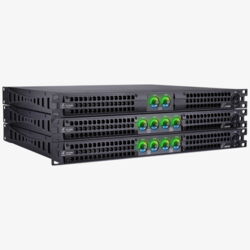
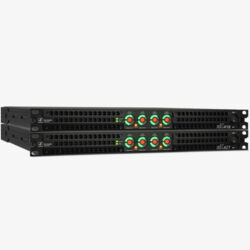
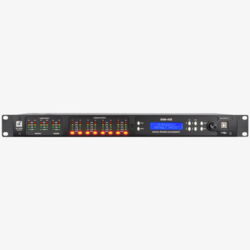
DSM-428-FIR
DSM-428-ULTIMATE
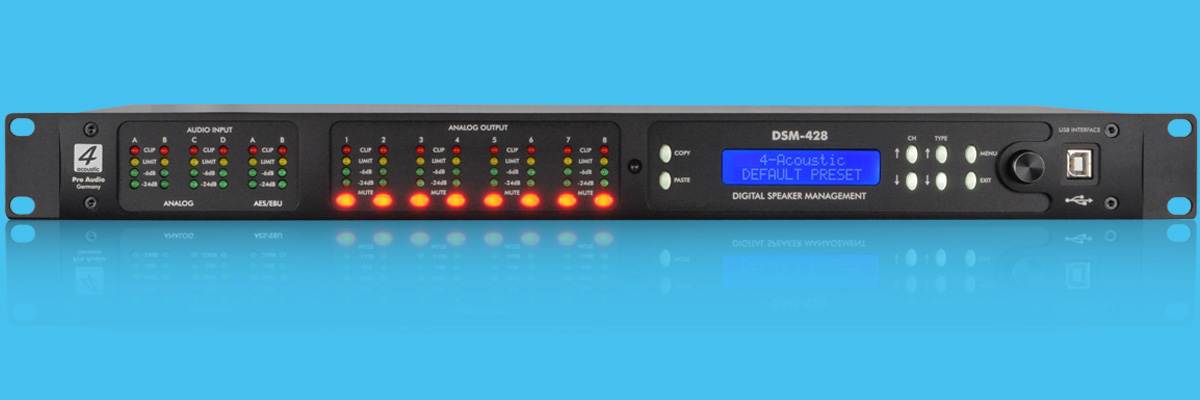
High-performance DSP speaker management
Die DSM-Komponenten sind leistungsstarke und hochmoderne Werkzeuge für das professionelle Lautsprechermanagement. Unsere DSM-428-Serie umfasst zwei Geräte, die Sie mit deutscher DSP-Technologie auf höchstem Niveau überzeugen werden.
Characteristics of the input and output stages
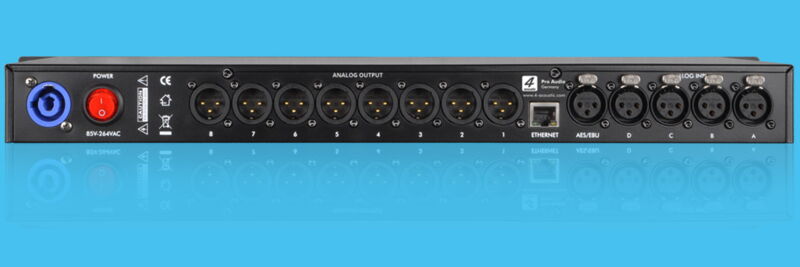
Both models offer four electronically balanced analogue inputs and eight electronically balanced analogue outputs. The robust analogue input stage accepts input voltages of up to +24 dBu and boasts an impressive dynamic range of 135 dB(A) in the Ultimate version. The maximum output level is 12 dBu, or 18 dBu in the Ultimate version. An AES/EBU input connects to a two-channel digital input signal. To meet the requirements of Audio over IP, there are units available with optional AES67, AVB/Milan (Q1/2021) and Dante interfaces.
Features of the DSP Engine
The Ultimate version offers the following features:
- Up to 8 x 600 FIR taps
- 10 PEQs for each input and output channel
- Crossover filters with up to 48 dB/octave
- 4-band compressor/limiter
- Input and output matrix
These features underscore the high standard of the DSP series. Key parameters such as temperature, signal level and gain reduction are continuously logged and monitored. All functions can be controlled via the control panel or the DSM network application. When parameters are changed, all DSP settings and coefficients are recalculated in real time. Frequencies can be set with an accuracy of 1 Hz, delays with an accuracy of 15 microseconds and gains with an accuracy of 0.01 dB. When editing values via the control panel, some values are limited in their range. For example, the gain is set in steps of 0.25 dB in this case.
Features of the DSM network software
You can use the DSM Network software to access all DSM devices connected to the network. These may include speaker management processors, amplifiers, active speakers or active line arrays. You can group and control multiple devices on the DSM network, making it easy to configure large sound systems without any stress.
Everything Under Control
With our DSM software, you can monitor the Live Aktiv devices remotely and adjust the settings to suit your personal preferences. The Input section provides access to additional EQs, limiters and compressors, as well as delay settings that can be used as a delay line or near-fill supplement with proper time alignment.
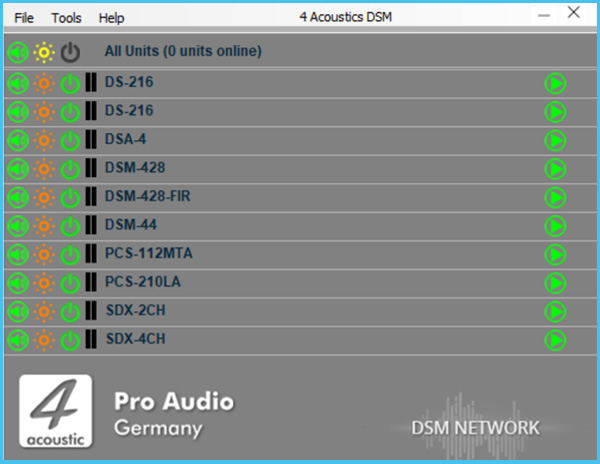
DSM Network Client
A single software solution for all devices. The DSM Network Client automatically scans the connected network and lists the DSM devices it finds. These may include SDX power amplifiers, active speakers, active line array speakers or DSM 19´´ devices. With just one click, you can open the configuration menu for the corresponding device. You can also group devices in the Network Client, allowing you to apply configuration changes quickly and reliably across the entire group.
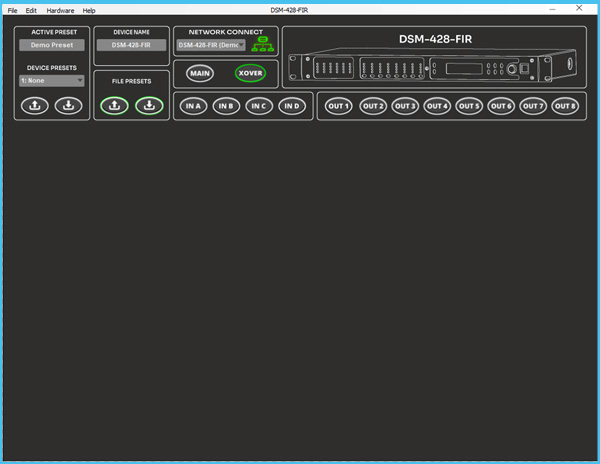
DSM Navigation Menu
To minimise the need to switch between different sections of the software, the navigation menu is located above all panels. The active preset display is on the left and may also include settings that were adjusted during operation. These settings are automatically saved in the active preset and remain available even after a restart. To save the active preset as a fixed preset on the device, assign a name, select the preset number and press the down arrow under 'Device Presets' to save it to the device memory. To load a preset from the device, select the preset number and press the up arrow. Please note that the active preset will be overwritten if it has not yet been saved. To save a preset to the computer, use the 'File Preset' function. The name displayed on the device and the network client can be customised under 'Device Name'. Use the menu buttons to navigate to the relevant configuration panels.
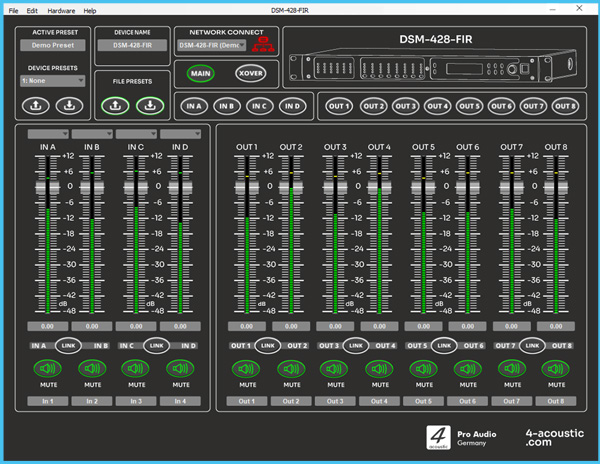
DSM Main Panel
The main panel provides an overview of all the input and output channels, and is fitted with gain controls and level meters. Each channel has a mute button. When operating in stereo mode, inputs A+B and C+D, as well as outputs 1+2, 3+4, 5+6 and 7+8, can be linked. The four input channels feature an input matrix that allows the physical input jacks to be routed to the inputs. In the lower fields, all inputs and outputs can be labelled as required to facilitate the assignment of functions within the system.
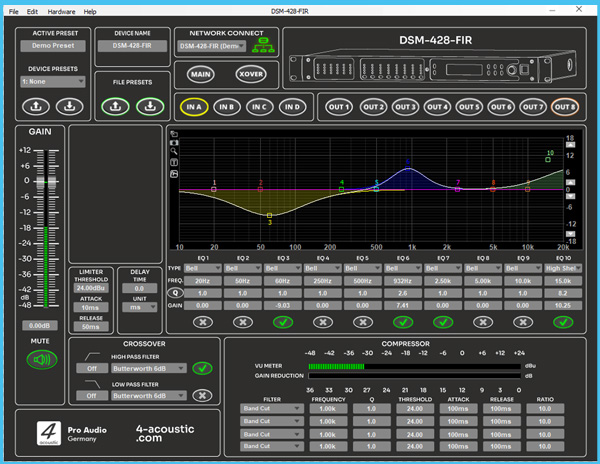
DSM Input Panel
The input panel is a high-quality tool for processing input signals within the DSM. Starting from the left, there is a gain control with a level meter and a mute button. To the right of that are the limiter and delay inputs, as well as the crossover settings for high- and low-pass filters. In the centre is the 10-band equaliser and filter unit. Each input also features a 4-band compressor-limiter located at the bottom of the EQ unit.
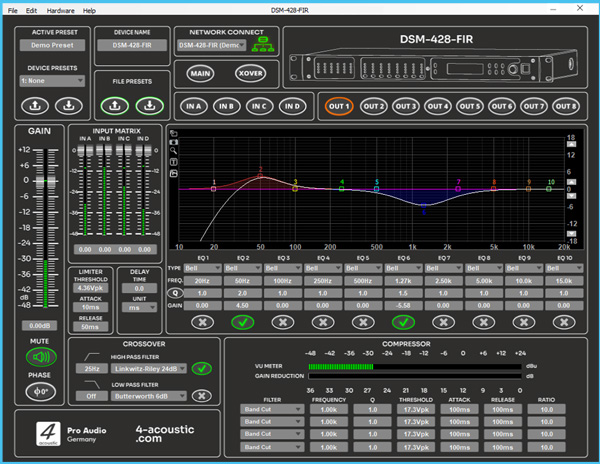
DSM Output Panel
The output panel is almost identical to the input panel. In addition to the output matrix, which allows any input to be routed to the output, it features a button for 180° phase reversal located below the Mute button. For FIR devices, FIR filter files for the corresponding output can be loaded via a menu accessible by clicking on the window displaying the graphs.
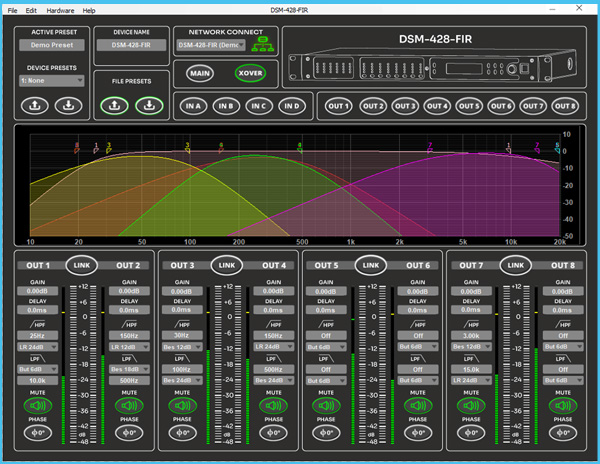
DSM Xover Panel
The Xover panel was originally designed to provide a quick overview of the high-pass and low-pass filter settings. Since then, it has evolved into a multifunctional panel that enables users to monitor and adjust a wide range of settings.
Technical Specifications
| Model | DSM-428-FIR | DSM-428-ULTIMATE |
| GS1 (EAN) CODE | 4260318511681 | 4260318510745 |
| System Type | 4 IN / 8 OUT Digital Speaker Management | 4 IN / 8 OUT Digital Speaker Management |
| Inputs | 4 analog inputs with 125 dB(A) Dynamic range 1 AES/EBU input (2-channel) AES67 + Dante (optional) |
4 analog inputs with 135 dB(A) Dynamic range 1 AES/EBU input (2-channel) AES67 + Dante (optional) |
| Max. input level | +24dBu | +24dBu |
| Input type | Electronic Symmetrical | Electronic Symmetrical |
| Input impedance (balanced) | 21 KOhm | 21 KOhm |
| Input impedance (single-ended) | 10,5 KOhm | 10,5 KOhm |
| Outputs | 8 analog outputs with a typical dynamic range of 120 dB(A) | 8 analog outputs with a typical dynamic range of 125 dB(A) |
| Output type | Electronic symmetrical impedance matching | Electronic symmetrical impedance matching |
| DSP THD (@0 dBu, 1 kHz) | <0,005 | <0,003 |
| DSP Frequency Range | 10Hz to 40kHz | 10Hz to 40kHz |
| Gain | 0 dB +/-0,5 dB | 0 dB +/-0,5 dB |
| Dynamic range | typ.120 dB(A) | typ.120 dB(A) |
| Dynamic range at a 12 dBu output level | >116 dB(A) | >120 dB(A) |
| EQ´s | 10 parametric filters per input and output | 10 parametric filters per input and output |
| EQ Type | Bell, High Shelf, Low Shelf, Notch, Allpass, Band Pass, High Pass, Low Pass |
Bell, High Shelf, Low Shelf, Notch, Allpass, Band Pass, High Pass, Low Pass |
| FIR | 8 x 384 Taps (Groupable) | 8 x 600 Taps (Groupable) |
| Delay times | 2000 ms delay per input, 50 ms delay per output |
2000 ms delay per input, 50 ms delay per output |
| Crossover | Butterworth, Bessel, Linkwitz-Riley filters up to 48dB / Oct. |
Butterworth, Bessel, Linkwitz-Riley filters up to 48dB / Oct. |
| Compressor / Limiter | 4-way for each input and output | 4-way for each input and output |
| Limiter | Adjustable Zero Attack Peak Limiter / True RMS Limiter |
Adjustable Zero Attack Peak Limiter / True RMS Limiter |
| Latency | 350 Microseconds | 350 Microseconds |
| Sample Rate | 96 kHz | 96 kHz |
| Presets | 250 storable presets | 250 storable presets |
| Processing | 64 bits multi-mode digital processing | 64 bits multi-mode digital processing |
| PC Remote | USB and Ethernet PC connection | USB and Ethernet PC connection |
| Operating Voltage | 85 VAC to 264 VAC | 85 VAC to 264 VAC |
| Dimensions (H/W/D) | 19“/1U 483W x 190D x 44H | 19“/1U 483W x 190D x 44H |
| Net weight | 2,55 kg | 2,55 kg |
Product Overview
Power Amplifiers and DSPs